

How Can You Identify a High-Quality Shower Tray?
Have you ever seen your carefully designed product fail in the field? A cracked or stained shower tray can be a designer’s worst nightmare, leading to angry clients and costly recalls.
You can identify a high-quality shower tray by examining three key areas: the superiority of its material, the precision of its manufacturing process, and the intelligence of its functional design. Materials like SMC, made via compression molding, are a clear sign of top-tier quality.
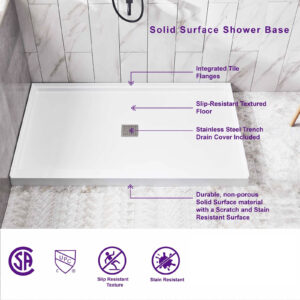
Choosing the right shower tray is more than a simple selection; it’s an engineering decision that impacts your project’s long-term success and your company’s reputation. I’ve spent my life in the molding industry, and I’ve seen firsthand what separates a product that lasts for decades from one that fails in a year. Let’s break down the details so you can become an expert in spotting true quality and making choices that reflect your high standards.
What Is the Best Material for a High-Quality Shower Tray?
Are you tired of specifying materials that promise durability but end up cracking under pressure? Choosing the wrong material can lead to product failure and damage your professional reputation.
Sheet Molding Compound (SMC) is the best material for high-quality shower trays. Its composite structure, made of glass fibers and thermoset resin, provides unmatched strength, thermal stability, and water resistance compared to traditional acrylic, ceramic, or basic stone resin.

When I first started in a mold factory, I worked with all sorts of plastics. I quickly learned that not all materials are created equal, especially for demanding applications like a bathroom. A shower tray endures daily abuse: impacts from dropped bottles, thermal shocks from hot and cold water, and chemical attacks from cleaning agents. This is where the science behind the material truly matters.
The Science Behind SMC’s Superiority
SMC is an advanced thermoset composite. Let’s break that down. “Thermoset” means that once the material is cured under heat and pressure, its chemical structure is permanently set. It cannot be melted or reshaped. This is why it has incredible thermal stability. The “composite” part refers to its internal recipe. It’s a high-tech blend of:
Polyester Resin: This forms the base matrix, providing chemical resistance and a non-porous surface.
Chopped Glass Fibers: These act like rebar in concrete, creating a strong internal skeleton that distributes stress and resists impacts.
Mineral Fillers (like Calcium Carbonate): These add rigidity, fire resistance, and give the tray a solid, stone-like feel.
During manufacturing, these ingredients are combined into a sheet. This sheet is then compression molded, creating a part that is incredibly dense and strong from the inside out.
Material Quality Comparison
For a designer like you, Jacky, seeing the data side-by-side is crucial. Here’s how SMC stacks up against the common alternatives I see in the market.
| Feature | SMC (Sheet Molding Compound) | Acrylic | Stone Resin (Cast) | Ceramic |
|———————|——————————|————————|————————|————————|
| Impact Resistance| Excellent (Absorbs shock) | Poor (Can crack) | Good (Can chip) | Very Poor (Brittle) |
| Thermal Stability | Excellent (-40°C to 180°C) | Poor (Deforms >70°C) | Good | Excellent |
| Weight| Lightweight (15kg/m²) | Very Lightweight | Very Heavy (50kg/m²) | Heavy |
| Surface Hardness | High (Resists scratches) | Low (Scratches easily) | High | Very High |
| Repairability | Good (Can be repaired) | Poor to Fair | Fair | Almost Impossible |
| Design Complexity | Very High (Integrated ribs)| Low | Medium | Low (Simple shapes) |
I remember a client who manufactured luxury RVs. They were using acrylic trays, and a whole shipment warped during transport through a hot climate. The financial loss was huge. They switched to SMC, and the problem disappeared overnight. The material’s stability is not just a lab number; it has real-world financial implications.
Does the Manufacturing Process Really Affect Quality?
Do you ever worry that a great design could be ruined by a flawed manufacturing process? Inconsistent production methods can create hidden weak spots that only show up after installation.
Yes, the process is critical. High-pressure compression molding, used for SMC, creates a uniformly dense, non-porous part with exceptional dimensional accuracy. This process is far more reliable and precise than the vacuum forming or manual casting used for other materials.

As someone who now runs a company that builds precision molds, I can tell you that the final quality of a part is a direct reflection of the process used to make it. A perfect design means nothing if the execution is poor.
A Look Inside High-Pressure Compression Molding
Making an SMC shower tray is a feat of engineering. Here’s a simplified look at the process I’ve overseen countless times:
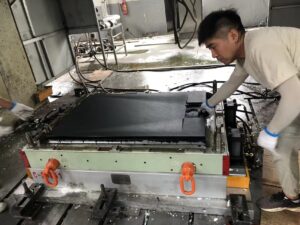
1. Charging the Mold: A precise amount of SMC sheet is cut and placed into a massive, heated steel mold. These molds are multi-million dollar assets, polished to a mirror finish.
2. Compression: A hydraulic press closes, applying immense pressure—often between 1,000 and 2,500 tons. This forces the SMC material to flow into every tiny detail of the mold cavity.
3. Curing: The heat and pressure trigger the thermosetting chemical reaction. The resin cross-links around the glass fibers, creating one solid, incredibly stable piece. This entire cycle takes only a few minutes.
This process eliminates air pockets and ensures the density is uniform throughout the tray. The back of the tray can be molded with complex reinforcing ribs for strength without adding weight. The result is a part that is perfect from the first unit to the ten-thousandth.
The Weaknesses of Other Manufacturing Methods
Contrast this with how other trays are made.
Vacuum Forming (for Acrylic): A thin sheet of acrylic is heated until soft, then draped over a simple mold. A vacuum sucks the sheet down to take the mold’s shape. The problem? The material stretches, becoming thinnest and weakest at the corners and base—exactly where strength is needed most. This inconsistency is a primary cause of cracking.
Casting (for Stone Resin): A liquid mixture of resin and stone powder is poured into a mold and left to cure. While better than vacuum forming, it’s prone to human error. Improper mixing can lead to inconsistent filler distribution. Air bubbles can get trapped, creating internal voids that become failure points under stress. It’s a much less controlled and repeatable process.
When you choose a product, you are also choosing its manufacturing pedigree. Compression molding is the pedigree of quality and consistency.
What Design Details Define a Superior Shower Tray?
Does it frustrate you when a product looks good but fails functionally? A tray that doesn’t drain properly or feels flimsy underfoot is a design failure, no matter how nice it looks.
A superior tray is defined by intelligent design details. These include a precisely engineered drainage slope of at least 2%, a non-porous and easy-to-clean surface, an integrated anti-slip texture, and a structurally reinforced base that prevents any flexing.
As a designer, Jacky, you know that God is in the details. In shower trays, these details make the difference between a satisfied customer and a frustrating callback. Because SMC is molded with such high precision, we can engineer these details directly into the product itself.
The Critical Importance of the Drainage Slope
Pooling water is the enemy. It leads to mold, mildew, and slippery soap scum buildup. A high-quality shower tray must have a perfect slope to guide every drop of water to the drain. The industry standard is a minimum slope of 2% (a 2cm drop for every 1m of length).
With SMC: This slope is engineered into the steel mold itself. Every single tray that comes out of the press has this exact, perfectly consistent slope.
With Tiled Floors: A tiler has to create this slope by hand with mortar. It is almost impossible to get it perfect and uniform. This often results in low spots where water pools.
Surface Engineering for Safety, Hygiene, and Feel
The surface of the tray is where the user interacts with the product every day.
Anti-Slip: A quality SMC tray has its anti-slip texture molded directly into the surface. This means it can’t wear off or peel away like cheap spray-on coatings. We can achieve certified anti-slip ratings (like Class C, the highest for wet areas) that last the lifetime of the product.
Hygiene: The surface of an SMC tray is typically a gel coat that is completely non-porous. It has no tiny holes for bacteria or dirt to hide in. This makes it incredibly easy to clean and far more hygienic than tile grout lines.
Feel: The solid mineral fillers in SMC give it a warm, pleasant feel underfoot, unlike the cold shock of ceramic or the flimsy flex of cheap acrylic.
Structural Integrity and Ease of Installation
A tray should feel rock-solid. Any flexing or creaking is a sign of poor quality.
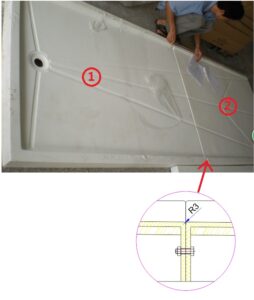
Reinforcement Ribs: The back of an SMC tray is designed with a grid of molded ribs. This is a brilliant engineering trick that adds immense rigidity and strength without adding much weight.
Perfect Flatness: The compression molding process creates a perfectly flat and stable base. This makes an installer’s job much easier. They don’t need to build up a thick mortar bed to level the tray and support it. A simple adhesive bed is enough, saving time and reducing the chances of installation errors. I always say a product isn’t truly well-designed unless it’s easy for the next person in the chain to work with.
How Is True Quality Verified and Guaranteed?
Can you really trust a supplier’s marketing claims? Without objective proof, “high quality” is just an empty phrase. You need to see evidence of rigorous testing and certification.
True quality is guaranteed through standardized, independent testing. This involves brutal tests for load capacity, impact resistance (EN 14527), thermal shock, chemical stain resistance, and slip resistance (DIN 51097) to prove the product will perform for decades.
In my business, we can’t just hope a mold is correct; we measure and verify everything. The same principle must apply to the final product. A top-tier manufacturer will be proud to show you their quality control data and certifications. If they can’t or won’t, it’s a major red flag.
Key Industry Standards to Look For
When you are evaluating a shower tray, ask the supplier for documentation showing compliance with these critical European Norms (EN), which are recognized globally as a benchmark for quality.
EN 14527: This is the master standard for shower trays. It specifies requirements for everything from water drainage and durability to surface stability. Passing this is non-negotiable.
EN 274: This standard governs the waste outlet, ensuring it drains correctly and can be connected to standard plumbing.
DIN 51097: This is a German standard for testing slip resistance in barefoot, wet areas. It classifies surfaces into Class A, B, or C. For safety, you should always look for a tray rated Class B or, ideally, Class C.
A Glimpse into a Quality Control Lab
I’ve spent a lot of time in these labs. The tests they run are designed to simulate a lifetime of abuse in a matter of weeks.
Load and Deflection Test: They place heavy weights (e.g., 300kg) on the tray and use precision sensors to measure how much it bends or “deflects.” A quality SMC tray will show minimal, almost immeasurable, deflection.
Impact Test: A steel ball of a specific weight is dropped from a set height onto the tray’s surface and drain area. The tray must show no cracks or damage. This simulates dropping a heavy shampoo bottle.
Thermal Cycling Test: This is the most brutal one. A machine automatically cycles thousands of times between flooding the tray with very hot water (e.g., 75°C) and very cold water (e.g., 12°C). This tests the material’s stability and ensures it won’t crack from repeated expansion and contraction.
Chemical and Stain Resistance Test: They apply common chemicals—like drain cleaner, hair dye, and bleach—to the surface for an extended period and then check for any staining or damage. A quality gel coat will wipe clean with no trace.
Seeing these tests gives you confidence that you are specifying a product built to last, not just a product built to sell.
Conclusion
Identifying a high-quality shower tray means looking beyond the surface. It requires understanding materials, manufacturing, design, and testing. SMC trays consistently deliver on all these fronts.