

Is Your Shower Base Forced to Be a Standard Size?
You’ve designed the perfect bathroom layout, only to find the standard shower base leaves a useless, awkward 10cm gap. You’re now forced to compromise your entire vision for the sake of an off-the-shelf part.
No, your shower base does not have to be a standard size. While standard dimensions offer mass-production efficiency, modern SMC manufacturing allows for cost-effective custom sizing. This empowers you to create a shower base that fits your exact space perfectly, eliminating design compromises.
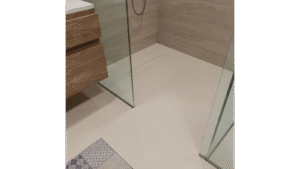
In my factory, I see the specifications for thousands of shower bases. The “standard” sizes are popular for a reason—they fit common building practices. But I’ve also seen the brilliant designs that get watered down when a designer like you, Jacky, is forced to pick a 120cm base for a 128cm space. It’s the difference between a tailored suit and one off the rack. Understanding why standard sizes exist, and how new technology overcomes their limits, is the key to achieving a truly custom, high-end result without the custom price tag.
Why Are There So Many Standard Shower Base Sizes?
You look at a supplier’s catalog and see a dizzying list of dimensions: 80×80, 90×90, 120×80, 140×90. It seems random, but it forces you to design around these fixed sizes from the very beginning.
Standard shower base sizes exist to match common construction dimensions and historical plumbing standards. They are optimized for mass production in traditional materials like acrylic or cast iron, where creating custom molds for every size would be incredibly expensive.
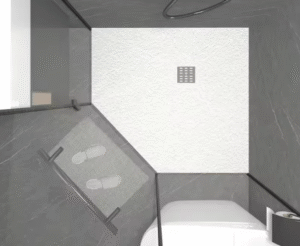
The logic behind standard sizes is rooted in industrial efficiency. Think about it. Creating a massive, high-pressure steel mold is a huge investment. To make it pay off, a factory needs to produce tens of thousands of identical units from that one mold. So, manufacturers created molds for sizes that matched the most common construction scenarios, like the 60-inch alcove left after removing a standard bathtub. This worked well for decades. The problem is, this forces the designer to adapt the space to the product. A modern design philosophy demands the opposite: the product must adapt to the space.
The Logic of Standardization
| Factor | Why it Leads to Standard Sizes |
|---|---|
| Construction Practices | Sizes align with standard stud spacing and common bathroom dimensions (e.g., bathtub alcoves). |
| Plumbing Standards | Drain locations are standardized to simplify plumbing installation across many projects. |
| Manufacturing Costs | High cost of molds for cast iron, ceramic, or acrylic makes a few popular sizes profitable. |
| Supply Chain & Stocking | It is easier for distributors to stock and sell a limited range of predictable sizes. |
Do Standard Sizes Force Bad Bathroom Layouts?
That standard base creates a gap that’s too small for anything useful but big enough to be a cleaning nightmare. You’re forced to add a clumsy filler strip or a tiny tiled ledge that looks like an afterthought.
Yes, absolutely. Forcing a standard size into a custom space is a primary cause of bad layouts. It leads to wasted space, awkward filler pieces, and design compromises that disrupt the flow and functionality of the entire bathroom.
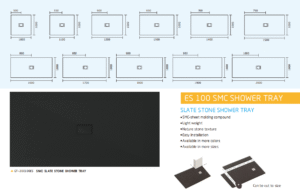
This is one of the biggest frustrations for a detail-oriented designer. The design should serve the user and the space, not the product catalog. When a 90cm base is forced into a 97cm opening, that 7cm gap becomes dead space. It collects dust, water, and hair. The “solution”—a tiled curb or wall extension—is a visual admission of compromise. It breaks the clean lines you worked so hard to create. I once saw a hotel project where they had to shrink every vanity by 10cm just to accommodate a standard shower base size across all the rooms. That is a terrible compromise, all because they didn’t know a better option was available.
Can a Custom Size Shower Base Be Affordable and Fast?
You hear “custom size” and immediately think of astronomical costs and a 12-week lead time. Your project budget and timeline simply can’t accommodate that kind of delay or expense, so you stick with the standard size.
Yes. Modern SMC manufacturing makes custom sizes both affordable and fast. Instead of a new mold for every size, we use smart molding techniques and post-production CNC trimming to deliver a perfect-fit base with lead times comparable to standard products.
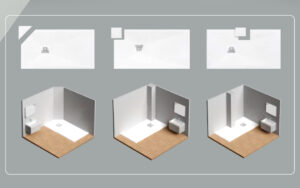
This is the technology that changes everything. With traditional materials like cast iron, “custom” means a whole new, unbelievably expensive mold. With SMC, we have two much smarter methods. First, for common requests, we use modular molds. These are brilliant steel molds with adjustable inserts that allow us to produce a range of sizes from a single tool. Second, and even more flexible, is CNC trimming. We can compression-mold a large, solid SMC slab with the drain position and surface texture already in place. Then, we use a computer-controlled CNC router to cut that slab to the exact millimeter dimensions you specify. This process is precise, fast, and uses material efficiently, making custom sizing a practical reality for almost any project.
Customization: Old vs. New
| Aspect | Traditional Materials (Acrylic, Cast Iron) | Modern SMC (Sheet Molding Compound) |
|---|---|---|
| Method | Requires a unique, dedicated mold. | Adjustable molds or CNC trimming of a larger slab. |
| Cost | Prohibitively expensive for a single unit. | Affordable, with only a modest premium over standard. |
| Lead Time | Months. | Weeks, often similar to standard order times. |
| Precision | Limited by the mold casting process. | Millimeter-perfect precision from CNC cutting. |
Conclusion
Standard sizes are an echo from a past era of manufacturing. With SMC, you are no longer forced to compromise. You can specify the exact size you need to create a perfect, gap-free, and truly custom bathroom layout.