

Which Shower Pan is the Best Choice for Modern Bathrooms?
You’re overwhelmed by the sheer number of shower pan options, from basic acrylic to custom tile, and you want to make the smartest long-term decision. But how do you cut through the noise and identify the single best option for your projects and clients?
The “best” shower pan largely depends on specific project needs, but for durability, aesthetics, and low maintenance, advanced engineered composite materials like SMC (Sheet Molding Compound) and Solid Surface generally outperform traditional options. They offer seamless designs, non-porosity, and superior longevity.
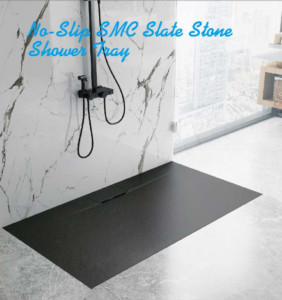
My time at MoldAll has shown me that “best” is a moving target. What was considered top-tier 20 years ago doesn’t hold up today. For designers like you, Jacky, the goal is often a balance of performance, aesthetics, and practicality. Early in my career, I saw many shower pans that looked great at first, but quickly faded, cracked, or grew mold. This inspired me to seek out and understand materials that truly deliver lasting value. When I talk about the “best,” I’m thinking about what will keep your clients happy for decades, not just what looks good in a showroom. It’s about material science meeting real-world demands. Let’s break down what truly makes a shower pan stand out in today’s market.
What Defines “Best” in a Modern Shower Pan?
You’re not just looking for a functional base; you need something that elevates a bathroom design. But with so many factors, how do you know what qualities truly matter when evaluating the “best” shower pan?
The “best” modern shower pan excels in several key areas: superior durability against daily wear, absolute non-porosity for hygiene and stain resistance, seamless aesthetic integration, ease of installation, and minimal long-term maintenance. It should also support accessibility and safety.
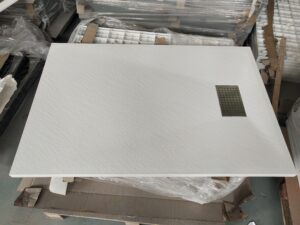
In my journey through the mold industry, I’ve learned that a truly great product solves problems without creating new ones. For a shower pan, “best” means it works hard so your clients don’t have to. First, durability is paramount. The shower pan takes constant abuse: hot water, soap, cleaning chemicals, dropped items, and heavy foot traffic. The best pan resists cracking, chipping, and fading. Second, non-porosity is a game-changer. Porous materials absorb water, which leads to mold, mildew, and stains. A non-porous pan stays cleaner, requires no sealing, and won’t harbor bacteria. Third, aesthetic integration means the pan complements your design, ideally offering a low-profile or curbless entry that visually expands the space and creates a spa-like feel. It should be available in textures and colors that match current trends and client preferences. Fourth, ease of installation for the builder and minimal maintenance for the homeowner are critical. A pan that installs quickly and then requires only a simple wipe-down saves everyone time and money. Finally, the “best” pan contributes to a safer bathroom by providing slip resistance and a barrier-free entry, enhancing accessibility for all users. These are the benchmarks I use when evaluating any shower pan product.
Core Metrics for the “Best” Shower Pan
|
Metric
|
Description
|
Why it Matters for “Best”
|
|---|---|---|
| Durability |
Resistance to impacts, scratches, chemicals, and wear
|
Ensures long product life, avoids costly replacements
|
| Non-Porosity |
Material does not absorb water or liquids
|
Prevents mold, mildew, stains; promotes hygiene
|
| Aesthetic Value |
Design flexibility, realistic textures, modern appearance
|
Meets client expectations for high-end, stylish bathrooms
|
| Maintenance |
Ease of cleaning, no need for special treatments or sealing
|
Reduces homeowner effort, saves money, long-term satisfaction
|
| Accessibility/Safety |
Low-profile/curbless entry, slip-resistant surface
|
Enhances user experience, prevents falls, future-proofs bathroom
|
| Installation Ease |
Pre-formed, consistent dimensions, lighter weight
|
Reduces labor costs, minimizes installation errors
|
Why Do Engineered Composites Outperform Traditional Options?
You’ve seen traditional shower pans struggle with leaks, stains, and constant upkeep. But what specific advantages do engineered composite materials offer that make them a consistently better choice?
Engineered composites like SMC and Solid Surface offer superior performance over traditional shower pans because they are inherently non-porous, uniformly strong, and precisely manufactured. This ensures a waterproof, durable, and low-maintenance base, unlike the variable quality and upkeep demands of tile or acrylic.
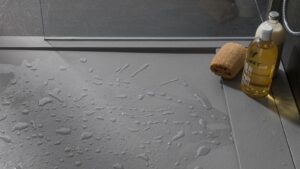
I’ve witnessed the evolution of shower pan technology firsthand, from the labor-intensive setting of mud beds and tiles to the precision manufacturing of composites. The biggest difference lies in control and consistency. Traditional tiled pans rely on a waterproof membrane and grout. If either fails, you have a leak. Grout lines are also a constant battle against mold and discoloration. Acrylic or fiberglass pans, while better than tile for seam reduction, can often feel flimsy, scratch easily, and sometimes yellow over time. Their inherent flexibility can also lead to cracking if not properly supported.
Engineered composites, on the other hand, are designed from the ground up for the shower environment. They are compression-molded or cast in a factory. This process creates a single, monolithic, non-porous piece. There are no grout lines to maintain and no hidden layers to fail. The materials themselves are formulated for high strength-to-weight ratios, meaning they are robust without being excessively heavy. For example, SMC incorporates reinforcing fibers for incredible impact resistance, while Solid Surface is a dense, homogeneous material that can be seamlessly repaired. These materials offer consistent quality, precise dimensions, and integrated drainage slopes that are impossible to achieve with on-site tiling. This factory precision means fewer variables during installation and a guaranteed performance that traditional methods simply cannot match. It’s about building in quality from the start, not hoping for it at the end.
Performance Comparison: Composite vs. Traditional
|
Feature
|
Tiled Pan
|
Acrylic/Fiberglass Pan
|
Engineered Composite Pan (SMC/Solid Surface)
|
|---|---|---|---|
| Waterproofing |
Relies on grout/membrane (prone to failure)
|
Surface waterproofing, prone to cracking
|
Inherently waterproof, non-porous
|
| Durability |
Brittle tiles, vulnerable grout, uneven
|
Prone to scratching, flexing, yellowing
|
High impact resistance, color stable, robust
|
| Maintenance |
High (grout cleaning, sealing, re-grouting)
|
Moderate (surface cleaning, scratch repair)
|
Low (simple wipe-down, no sealing)
|
| Aesthetics |
Highly customizable, but visually segmented
|
Limited textures, can look “plastic”
|
Realistic textures, seamless looks, high-end
|
| Installation |
Complex, lengthy, skilled labor needed
|
Relatively easy, but requires strong support
|
Easy, precise fit, lighter weight
|
| Cost |
High (labor + materials)
|
Moderate
|
Moderate to High (due to advanced materials)
|
Is There a Single “Best” Composite Pan, or Does it Depend on the Design?
You’re convinced composites are the way to go, but you’re now faced with options like SMC and Solid Surface. How do you decide which of these top-tier composite materials is the absolute “best” for your client’s specific vision and budget?
There is no single “best” composite pan; the ideal choice between top options like SMC and Solid Surface depends on specific design priorities. SMC excels at realistic textures and cost-efficiency for mass production, while Solid Surface offers unmatched seamless integration and repairability for a truly monolithic, luxurious feel.
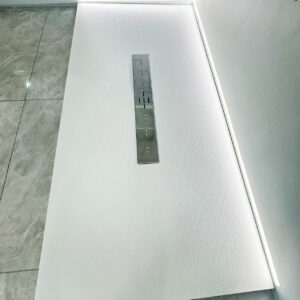
This is where your expertise as a designer comes in, Jacky. My team at MoldAll manufactures both, and I can tell you that while both are excellent, they cater to slightly different project needs. Think of it like choosing between two high-performance sports cars: both are fast, but one might be better for track days, and the other for luxurious touring.
SMC (Sheet Molding Compound) is often the “best” when you need to achieve an incredibly realistic, high-end natural stone or concrete look without the actual drawbacks of those materials. Because it’s compression molded, we can embed incredibly intricate textures into the mold itself, mimicking slate, river stones, or wood grain with stunning accuracy. These pans are also very strong, impact-resistant, and cost-effective when produced in volume. They are also through-colored, meaning the color goes all the way through the material, which helps hide minor wear and tear. If your client wants the tactile experience of stone and a robust, low-maintenance pan at a competitive price point, SMC is often the winner.
Solid Surface, on the other hand, truly shines when the goal is a seamless, monolithic aesthetic. It’s often chosen for its ability to integrate almost invisibly with Solid Surface wall panels, creating a “wet room” feel with virtually no visible seams or grout lines. The material itself is homogeneous, offering a smooth, luxurious feel that is warm to the touch. It’s also fully repairable; minor scratches and even deeper damage can be sanded out or patched seamlessly by a professional, extending the life of the product indefinitely. While often a higher investment, Solid Surface delivers unparalleled luxury, complete design freedom for custom shapes, and a unique repairability that SMC does not offer. For a minimalist, ultra-clean, and truly integrated design where budget allows, Solid Surface often takes the “best” title.
Choosing Your “Best” Composite Pan
|
Feature
|
SMC Shower Pan
|
Solid Surface Shower Pan
|
Best For:
|
|---|---|---|---|
| Aesthetic Focus |
Realistic natural textures (stone, slate)
|
Seamless, uniform, modern, integrated
|
High-end natural look, tactile experience
|
| Integration |
Excellent as standalone unit, precise fit
|
Unmatched for seamless wall-to-pan integration
|
Monolithic wet room design, ultra-clean lines
|
| Repairability |
Minor surface scratches, generally not field-repairable for deep damage
|
Excellent, can be sanded, polished, and patched
|
Longevity, commercial use, high-traffic areas
|
| Cost-Efficiency |
Very good for textured, high-volume production
|
Higher initial cost, but long-term value through repairability
|
Project budgets with realistic texture demands
|
| Texture Options |
Highly varied, deep, and realistic textures
|
Smooth, matte, satin, or polished finishes
|
Specific tactile preferences, detailed surface effects
|
Conclusion
The “best” shower pan ultimately matches your project’s unique needs, but engineered composites like SMC and Solid Surface stand out. They consistently deliver superior durability, hygiene, and aesthetic appeal over traditional options, ensuring a high-quality, long-lasting solution for modern bathrooms.